
EV Sales Customer Experience Training: A Beginner-Friendly Showroom Framework

EV customers don’t just buy a vehicle—they buy into a new routine. Charging, range confidence, and long-term value can feel unfamiliar, even for customers who already like the idea of going electric. That uncertainty is exactly why EV sales works best when it feels less like “closing” and more like guiding.
This beginner-friendly guide introduces a simple customer-experience (CX) framework you can use in a showroom conversation. It’s intentionally high-level: enough to improve clarity and confidence, but not a substitute for training where you practice real conversations, learn consistent methods, and receive feedback.
By the end, you’ll understand:
A simple 4-part CX framework for EV sales
How to align your pitch with a customer’s routine (without getting overly technical)
A light showroom checklist to keep your process consistent
How to handle common EV objections safely and honestly
What to do next if you want structured, guided learning
Why EV sales needs a customer-experience approach
EV buyers often arrive excited and cautious at the same time. Many have never owned an EV, and they may worry about charging convenience, real-world range, battery longevity, and whether the switch is “worth it.”
When customers feel uncertain, two things usually backfire:
Overloading with specs too early (it creates confusion)
Being too vague (it creates doubt)
A CX approach helps because it:
Reduces uncertainty with structure (customers feel guided)
Builds trust by focusing on the customer’s real routine, not just features
Keeps the conversation credible (no need for exaggerated claims)
Improves consistency across a sales team
Green Motion Academy : https://www.greenmotionacademy.com/
The 4-part EV Sales CX framework
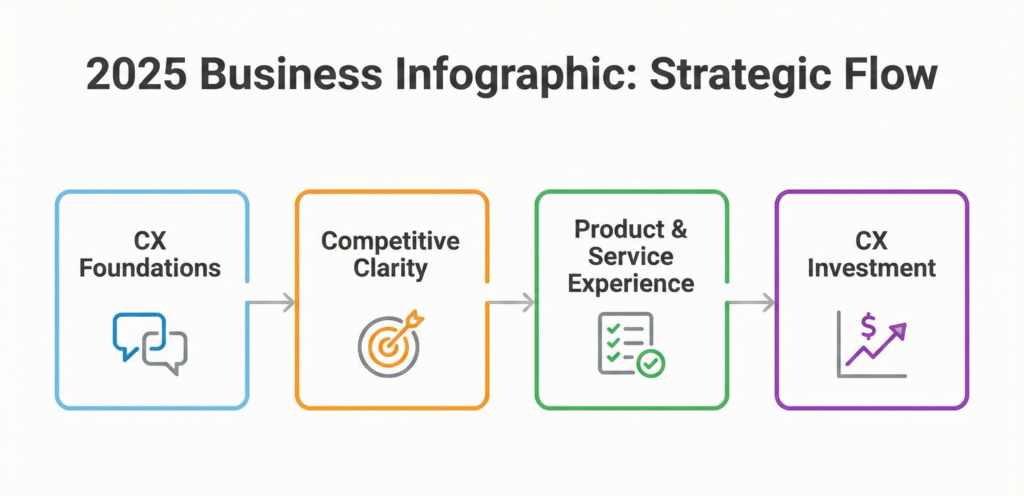
Use this as your internal roadmap. You don’t need to memorize scripts—you just need to keep the conversation moving through the right stages.
1) CX Foundations: clarify what “success” looks like for this customer
Many EV conversations fail because the seller talks about the vehicle before understanding the customer’s daily life.
At a beginner level, your job is to learn four basics:
Routine: How they drive on typical weekdays
Parking situation: Where the car sits most nights
Charging reality: What’s realistically available (not “ideal”)
The worry: The one concern that blocks confidence
If you can summarize their situation in one sentence, you’re doing CX selling:
“You mainly commute, you park in an apartment building, and your main concern is charging convenience.”
That single sentence creates clarity and makes the customer feel heard.
2) Competitive clarity: position the right value (not every spec)
Most EV customers compare options quickly. Your job isn’t to “win” every spec battle. Your job is to show why a particular option is the best fit for their routine and priorities.
To stay credible:
Lead with what the customer cares about most (convenience, cost predictability, comfort, tech)
Use only facts you can stand behind (official specs, official warranty terms, verified local reality)
Avoid absolute claims like “always,” “never,” “best,” or “zero maintenance”
A useful positioning line that stays consultative:
“Let’s choose based on what will be easiest and most confident for you to own day-to-day.”
3) Product & service experience: make EV ownership feel simple
EV sales improves when customers can imagine ownership without stress. That doesn’t require technical depth—it requires clarity.
At a beginner level, that means:
Explaining key ideas in plain language (charging types, basic range reality, what impacts range)
Using one small “confidence demonstration” tied to their routine
Showing the support pathway (where technical questions go; how service support works)
Your goal is not to teach everything. Your goal is to reduce “unknowns” enough to make the next step feel safe.
4) CX investment: small improvements that increase trust and conversion
You don’t need complicated systems to improve CX. A few consistent behaviors often make the difference:
A consistent conversation structure your team uses every time
A clear follow-up routine so customers don’t feel abandoned
A simple “what happens next” explanation after a test drive or quote
Consistency is a customer experience upgrade.
EV Sales CX course page : https://www.greenmotionacademy.com/enroll-now/
Practical example: one persona, one showroom approach
Let’s keep this practical and showroom-only.
Persona example: “Apartment commuter + occasional weekend trips”
What they typically want:
Confidence that daily driving works smoothly
Charging that feels manageable
Predictable ownership experience
A plan for occasional longer trips
A beginner-friendly showroom approach:
Confirm their routine and worry in one sentence
Recommend one or two options and explain why they fit
Walk through a simple “what a normal week looks like” scenario
Offer one confidence-building next step (test drive, quote, or summary)
This keeps the conversation calm, structured, and customer-centered—without turning it into a technical lecture.
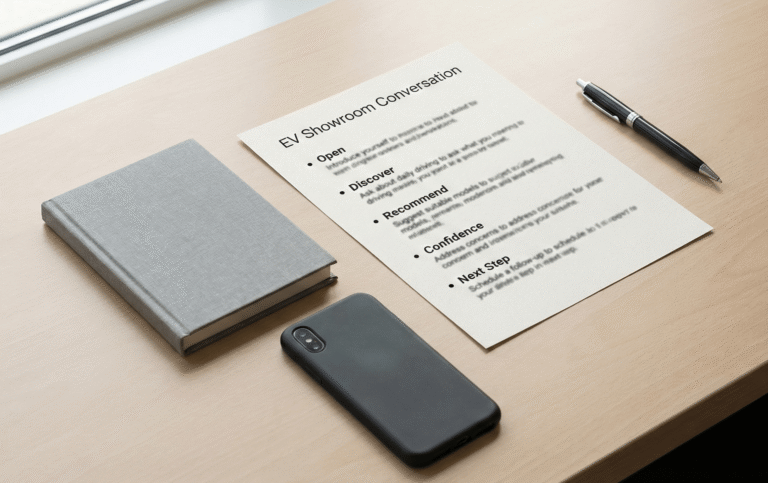
A light showroom checklist (beginner level)
This is not a full SOP. It’s a simple structure to keep your EV conversations consistent.
Step 1: Open and align (1–2 minutes)
Confirm their intent: browsing vs comparing vs ready to decide
Ask permission to guide: “Can I ask a few quick questions so I recommend correctly?”
Step 2: Discover the routine (3–5 minutes)
Focus on:
Typical weekday distance and usage
Parking situation and charging possibilities
Biggest worry (the one blocker)
Priority (cost / convenience / comfort / tech)
Step 3: Recommend with clarity (2–4 minutes)
Limit to 1–2 options
Explain the match in plain language (“fit”), not a feature dump
Stay credible—don’t overpromise
Step 4: Build confidence (5–10 minutes)
Use one short demonstration tied to their worry
Example: “Here’s how your week could work, realistically.”
Step 5: Next step + follow-up plan (1–2 minutes)
Offer one clear next step (test drive, quote, or summary)
Confirm timing and expectations: “Would you like to continue today or follow up after you review?”
Suggested internal link here → Blog : https://www.greenmotionacademy.com/blog/
Common EV objections (handled safely and honestly)
A strong EV salesperson doesn’t “win” objections. They reduce uncertainty without making claims they can’t support.
A simple response method:
Acknowledge → Clarify → Next step
Acknowledge: “That’s a valid concern.”
Clarify: “Is it charging access, charging time, or trip confidence?”
Next step: “Let’s look at what ownership would realistically look like for you.”
Four common objections to expect:
Range anxiety → Keep it routine-based; avoid promising real-world outcomes.
Charging convenience → Focus on realistic routines; avoid “easy everywhere” claims.
Battery concerns → Refer to official warranty terms; avoid guarantees beyond OEM info.
Safety concerns → Keep it compliance-based; avoid technical repair explanations.
If the customer needs deep technical answers, the most credible response is simple:
“That’s an important technical question. Let’s confirm using official documentation or our qualified technical team.”
How to build trust without over-claiming (E-E-A-T)
EV buyers are sensitive to exaggeration. Trust grows when your sales approach is consistent, responsible, and transparent.
Add a small credibility box to your page like:
How we teach: “Our training focuses on structured frameworks and guided practice so teams can deliver a consistent customer experience.”
Responsible accuracy: “Technical details should be verified using official OEM documentation and qualified technical staff.”
Transparency: “This article is an overview; training includes practice, feedback, and tools/templates used in real scenarios.”
About Us: https://www.greenmotionacademy.com/about-us/
Next step: learn faster with guided training
This blog is designed to help you understand the shape of EV CX selling. If you want to improve faster—especially handling difficult objections and building consistent team performance—guided training helps because you practice the framework and get feedback.
Light CTA (keep it simple):
Ready to build EV sales confidence with a structured approach?
Request intake details → https://www.greenmotionacademy.com/enroll-now/
Book a call / ask a question → https://www.greenmotionacademy.com/contact-us/
