
EV Technical Training Basics: A Safe Beginner Overview of EV Systems, Batteries, Charging & Diagnostics
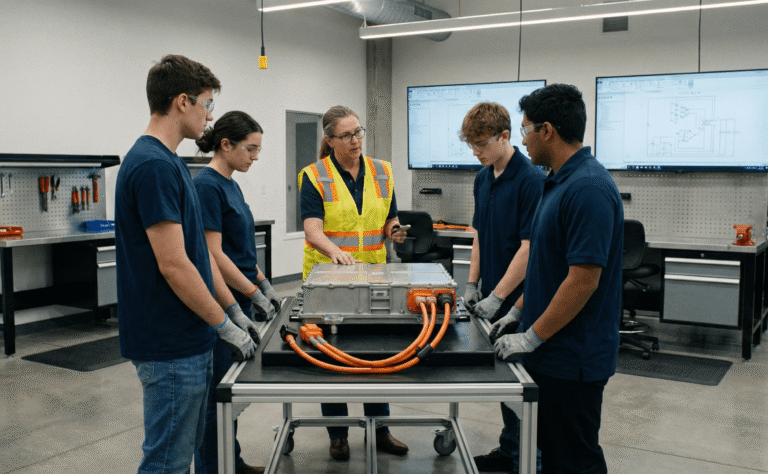
If you’re new to EV technical learning, it can feel like there’s “too much” at once: batteries, charging, power electronics, software, and safety rules. The good news is you don’t need to master everything to start, you need a safe mental model and a clear learning path.
This post is a beginner-friendly overview of what EV technical training fundamentals usually include: the core EV systems, battery and charging basics, a responsible diagnostics mindset, and the safety habits that come first. It’s intentionally high-level, enough to help you understand how EV technical work is structured, without giving step-by-step procedures that belong in supervised training.
What you’ll learn in this overview:
A simple EV system map you can remember
Battery concepts in plain language
AC vs DC charging at a beginner level
A safe diagnostics mindset (how technicians think)
A safety readiness checklist for learning in high-voltage contexts
Green Motion Academy: https://www.greenmotionacademy.com/
What EV technical training covers (and what it doesn’t)
Beginner EV technical training is usually about foundations, understanding how the system works and how to stay safe, before doing advanced diagnostics or any maintenance tasks.
At a high level, foundations often include:
EV architecture (how energy flows through the vehicle)
Batteries and battery management basics
Charging systems and charging infrastructure concepts
Introductory diagnostics thinking (symptoms → isolate → verify)
Safety mindset for high-voltage environments
What this blog post does NOT do: teach repair steps, provide isolation procedures, or tell you “how to fix” a specific fault. Those belong in formal training environments with proper equipment, supervision, and OEM guidance.
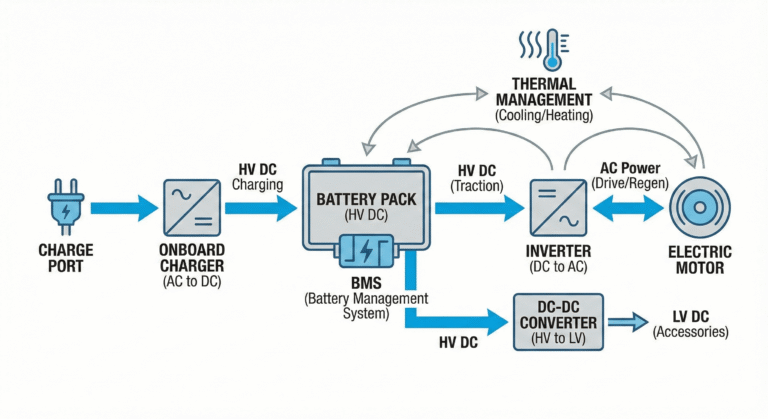
The EV system map (a beginner mental model)
Before you learn tools, codes, or deeper testing, it helps to understand the EV like a simple energy story:
Energy is stored (in the battery pack)
Energy is managed (by control systems like the BMS)
Energy is converted (by power electronics)
Energy becomes motion (through the electric motor)
Energy is replenished (through charging systems)
Here are common building blocks you’ll hear in training—kept intentionally simple:
Battery pack: Stores energy (think “fuel tank,” but electrical).
Battery Management System (BMS): Watches battery health, temperature, and balance (think “safety + management”).
Inverter / power electronics: Helps convert energy into the form the motor needs (think “translator”).
Electric motor: Turns electrical energy into movement.
On-board charger (OBC): Manages certain types of charging into the battery.
Thermal management: Helps keep the battery and systems within safe temperature ranges.
If you can remember the story, store → manage → convert → move → replenish, you’ll learn faster in any structured course.
Battery basics in plain language
Batteries can seem intimidating, but the beginner-level goal is simply to understand what people mean when they talk about “battery performance” and “battery health.”
Here are four concepts you’ll encounter often:
1) Energy capacity (kWh) — “How much energy can it store?”
Higher energy capacity usually supports longer driving range, but real-world range depends on driving speed, temperature, terrain, and more.
2) State of charge (SOC) — “How full is it right now?”
SOC is the day-to-day indicator of charge level.
3) State of health (SOH) — “How healthy is the battery over time?”
SOH is a long-term concept: how the battery’s ability to store and deliver energy changes with age and usage. You never want to “promise” SOH outcomes in casual conversations—this is where training and OEM guidance matter.
4) Thermal management — “Temperature affects performance and longevity”
Heat and cold influence battery behavior. At a beginner level, just remember: temperature matters, and systems exist to manage it.
This isn’t about memorising formulas. It’s about building comfort with the vocabulary so you can learn safely and accurately later.
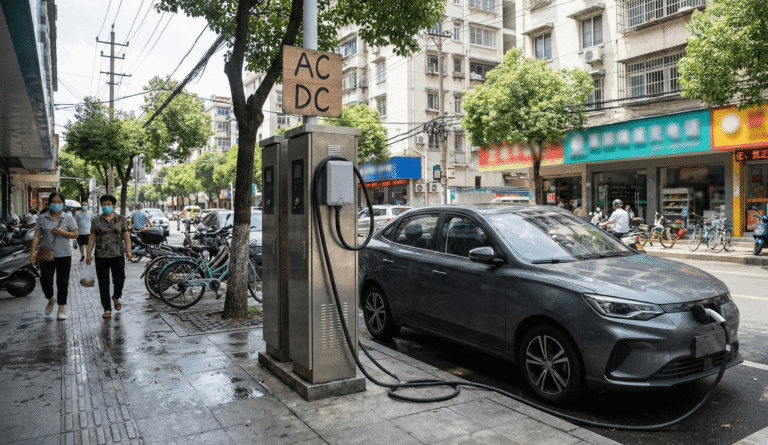
Charging basics: AC vs DC
Charging is a common “technical” topic that beginners can understand quickly if you keep it simple.
AC charging (high-level)
AC charging is often associated with longer, steady charging sessions (for example: workplace or residential environments). It’s a foundation topic because it helps you understand daily ownership patterns and basic charging workflows.
DC charging (high-level)
DC charging is often associated with faster top-ups in certain contexts (for example: travel corridors or high-traffic stations). The key beginner idea: DC is a different type of charging scenario and infrastructure, and the experience depends on equipment capabilities and compatibility.
Beginner reminder: Avoid blanket statements like “fast charging is always available” or “charging is always quick.” Charging experience depends on the charger type, vehicle capability, site conditions, and local infrastructure.
Practical example (beginner-level)
Two people can choose EVs differently based on charging reality:
Apartment commuter: prioritises convenient public charging access and a routine that fits daily life
Fleet/operator: prioritises predictable uptime and planning around operational needs
The goal isn’t to become a charging engineer, it’s to understand the basics so you can learn the right things next.
Diagnostics mindset for beginners (how technicians think)
Diagnostics is not “guessing.” It’s a disciplined way of narrowing down causes safely.
A beginner-friendly mindset looks like this:
Start with the symptom
What exactly is happening? When does it occur?
Confirm and isolate
Is it consistent? Is it linked to a condition (temperature, speed, charging)?
Verify with reliable sources
OEM information, training materials, qualified supervision
Escalate when needed
High-voltage systems require appropriate training and authorization
In training, learners practice systematic thinking and safe workflows. In a blog post, the key takeaway is simpler:
Good diagnostics is structured, safe, and evidence-driven, not “try this and see.”
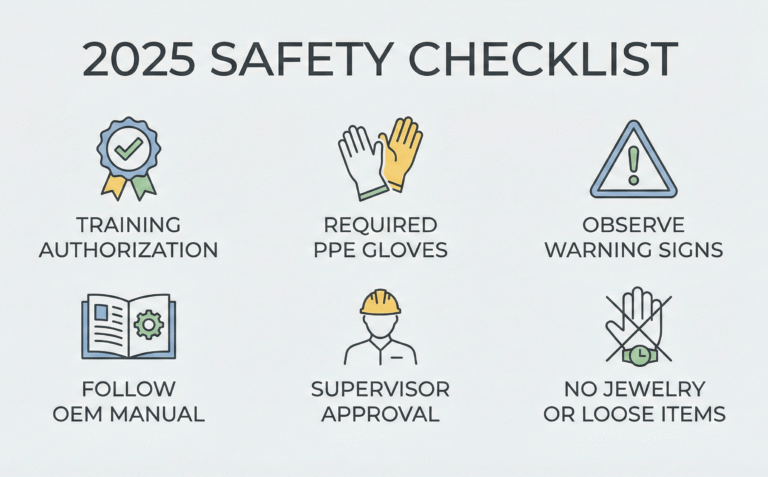
Safety readiness checklist (high-level)
Safety is the first technical skill in EV work. This checklist is intentionally high-level.
EV Safety Readiness Checklist (Beginner)
Training and authorization: You should only work within your training level and permissions
OEM documentation mindset: Verify specs and procedures from official sources
PPE awareness: Use appropriate protective equipment as required in your environment
Work area discipline: Clear signage, controlled access, no distractions
Risk awareness: Treat high-voltage components with respect; don’t improvise
Supervision and escalation: When unsure, stop and escalate to a qualified supervisor/technician
Safety note again: This is not an isolation procedure or repair instruction. Hands-on high-voltage work belongs in supervised training environments.
Next step: learn faster with hands-on training
This blog gives you the overview, the vocabulary and the mental model. Training is where those concepts become practical, with guided labs, supervision, and feedback.
If you want a structured pathway into EV technical fundamentals, systems, batteries, charging concepts, and a safe diagnostics mindset, explore Green Motion Academy’s EV technical training options.
Explore EV training → https://www.greenmotionacademy.com/
Request intake details → https://www.greenmotionacademy.com/enroll-now/
Book a call / ask a question → https://www.greenmotionacademy.com/contact-us/
About Us: https://www.greenmotionacademy.com/about-us/
Blog : https://www.greenmotionacademy.com/blog/

You may also like
TikTok Shop Livestream Selling Checklist: A Beginner-Friendly Framework (Flow + Metrics + Trust)
Most beginner livestreams don’t fail because the host lacks confidence—they fail because the live has no structure. Viewers arrive, feel uncertain about what’s happening, and leave before the product story becomes clear. This article gives you an overview-level TikTok Shop …
Personal Shopping & Livestream Training: How Retail Teams Deliver Better Experiences (In-Store + Live)
Modern retail customers expect two things at once: personalisation and speed. They want to feel understood—without spending an hour explaining themselves. And if they shop through livestreams, they still want the same thing: clear guidance, honest information, and a confident …
EV customers don’t just buy a vehicle—they buy into a new routine. Charging, range confidence, and long-term value can feel unfamiliar, even for customers who already like the idea of going electric. That uncertainty is exactly why EV sales works …