
STEP 01
Receive enquiry
Identify an eligible message in an approved email or CRM queue.
GMA Executive Intelligence Series / 2027
A practical executive framework for improving customer enquiries, lead qualification and follow-up, and preparing a measurable AI pilot.
For CEOs, SME owners and commercial leaders
Start with a defined commercial challenge. Explore four practical applications where AI-assisted work can support your team.
Prepare consistent responses using approved information.
Research prospective companies and evaluate fit.
Route campaign responses to accountable sales owners.
Prioritise eligible enquiries and record next actions.

Independent research / 2025
Average issues resolved per hour
A study by Brynjolfsson, Li and Raymond examined a conversational assistant in a large customer-support operation. Average productivity increased, with different effects across workers.
Use this evidence as a starting hypothesis for a comparable workflow. Establish your own baseline and evaluate quality, adoption and commercial outcomes.
Read the peer-reviewed studyThe measure concerns support issues resolved per hour in the study setting; sales and cash outcomes require separate evaluation.
Research context: November 2026 edition
OECD (2025) examines the barriers to AI adoption among SMEs, including skills, data and organisational readiness. The Columbia Business School working paper on online retail reports varying results across applications and settings. Neither establishes expected returns for a GMA project.
Read OECD's SME AI adoption paper
Read the online retail working paper
Editorial note: GMA's examples, financial assumptions and programme designs are illustrative. External study findings are not GMA client results or guaranteed business outcomes.
Illustrative worked scenario
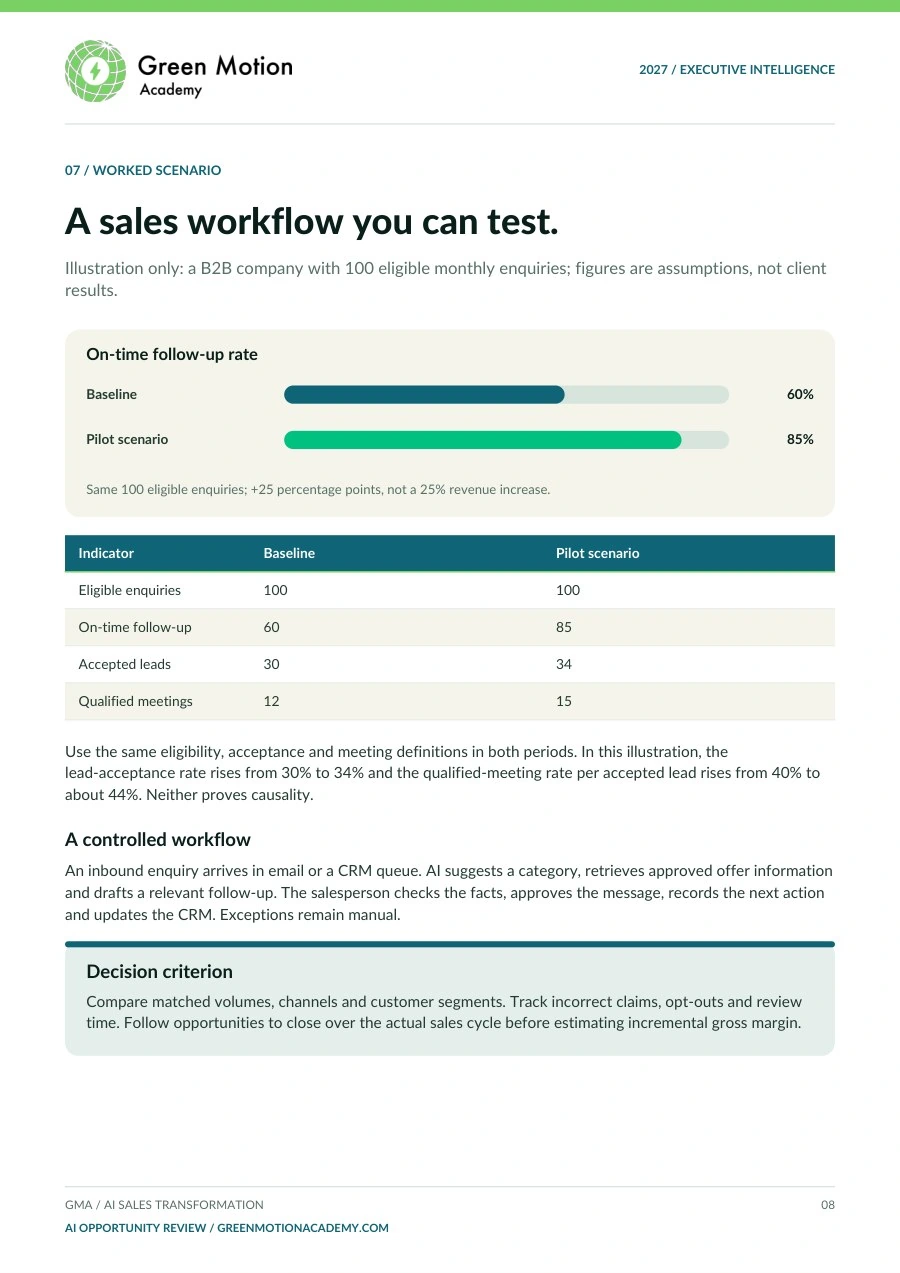
Consider a B2B company with 100 eligible monthly enquiries. A controlled pilot can help the team test whether timely follow-up improves.
Use the same eligibility, acceptance and meeting definitions.
Review factual accuracy, opt-outs, staff review time and qualified meetings.
On-time follow-up rate
Illustrative planning example, based on page 8 of the Playbook.
Practical workflow design
Keep the process contained, assign a responsible owner and use approved information at each step.
Identify an eligible message in an approved email or CRM queue.
Retrieve approved product, service and customer information.
Use AI assistance to propose a relevant response.
Check facts, scope, tone and approval requirements.
Use the approved communication channel after review.
Log outcome, follow-up and exceptions; handle exceptions manually.
Inside the 24-page publication
Preview selected pages from the actual English edition. Explore the research, workflow design, implementation roadmap and pilot charter.
Page 3. Understand findings and their relevance to your workflow.
Page 8. Evaluate a controlled sales follow-up example.
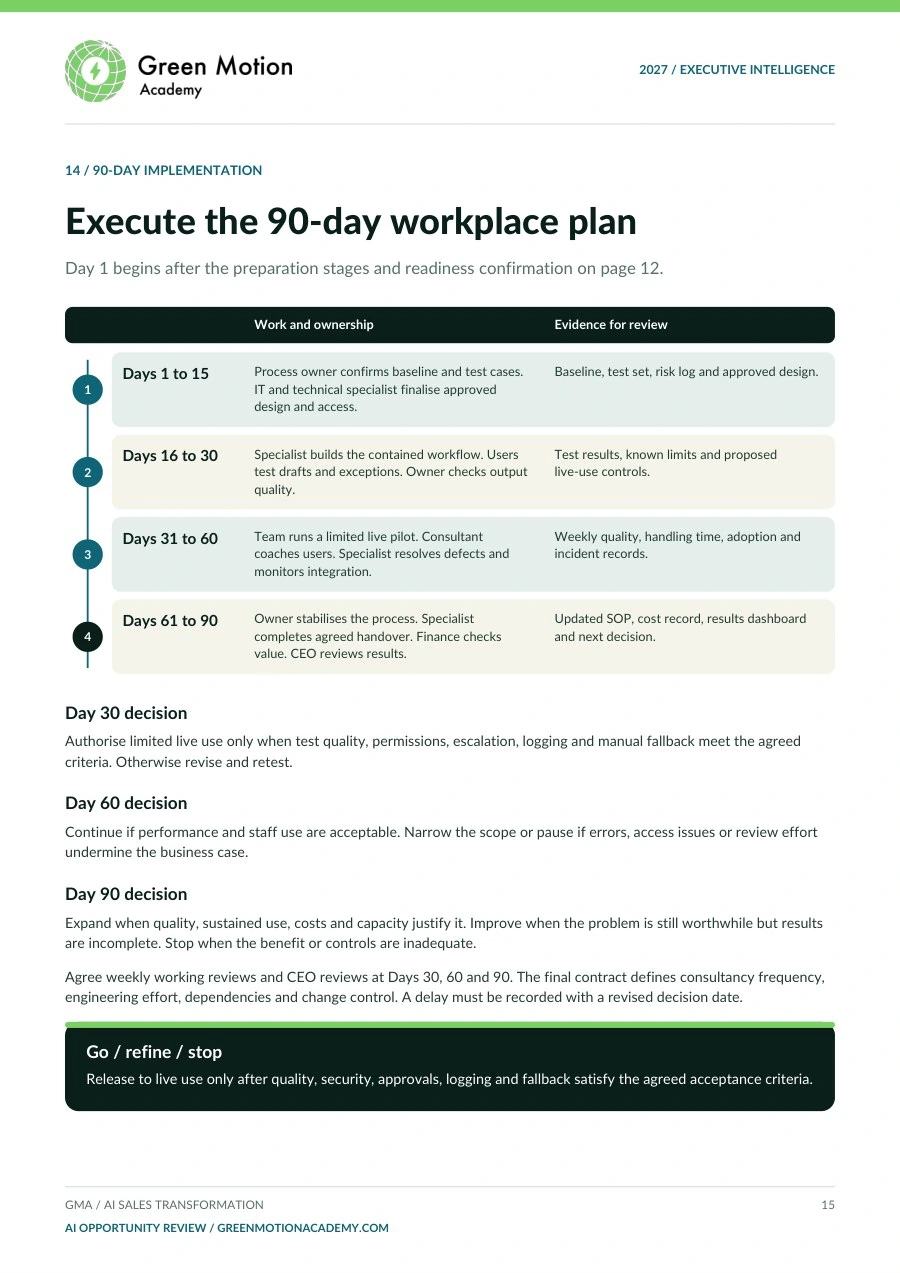
Page 15. Review ownership, evidence and decision gates.
Page 22. Prepare the business and technical requirements.
From learning to application
The Playbook outlines a staged transformation journey, connecting preparation and China learning with a scoped implementation period.
Prioritise an opportunity and baseline gaps.
Prepare the pilot charter and change plan.
Study relevant applications and conditions for transfer.
Agree scope, owners, access and controls.
Test, coach users and evaluate results.
The workplace execution period follows preparation and readiness approval. Commercial engagements and technical responsibilities are scoped separately.
Workplace implementation / 90 days
Define the evidence needed for each stage, with decision points at Day 30, Day 60 and Day 90.
Confirm measures, permissions, test cases and approved design.
Baseline and risk log
Build contained workflow, test drafts and review output quality.
Day 30: live-use decision
Coach staff, track quality, adoption and defects.
Day 60: continue or revise
Review cost, evidence, operating guide and next investment.
Day 90: executive decision
Investment decision / illustrative model
Estimate potential capacity value using your own workflow baseline, then account for realisation and recurring costs.
40 hours of potential released capacity per month.
S$1,200 potential monthly capacity value before realisation and running costs.
Include tools, data and support in the actual business case.
Illustrative capacity-value calculation
Capacity represents time available for redeployment. Actual cash savings require a separate expenditure assessment. Setup, travel and other costs are additional.
Executive resource / frequently asked questions
The 2027 English edition of AI Transformation for Sales & Customer Service combines research, workflows, investment examples and a pilot charter.
SME owners, CEOs and commercial leaders exploring AI in sales and customer service.
24 pages covering evidence, commercial workflows, implementation, economics, governance and a practical pilot charter.
Select a priority workflow, agree readiness and responsibilities, then use the stages and review gates to evaluate a controlled pilot.
The English edition is featured here. Bahasa Indonesia and Simplified Chinese editions have their own protected delivery pathways.
The English edition is sent through a private email link.
The publication is a standalone educational resource. An optional commercial discussion can help scope a project around your objectives.