
Personal Shopping & Livestream Training: How Retail Teams Deliver Better Experiences (In-Store + Live)
- Date December 29, 2025

Modern retail customers expect two things at once: personalisation and speed. They want to feel understood—without spending an hour explaining themselves. And if they shop through livestreams, they still want the same thing: clear guidance, honest information, and a confident host who makes the decision feel easy.
This article gives you a beginner-friendly overview of personal shopping and livestream training, the “shape” of the skills, not the full training content. You’ll learn a simple framework you can apply immediately, plus a light checklist to make your next live session smoother. If you want the hands-on practice, scripts, and coaching that make these skills feel natural, that’s where guided training becomes valuable.
What you’ll learn today:
A simple CX framework that works in-store and on livestream
How to identify customer needs quickly (without complicated profiling)
How to curate products in a way that feels helpful, not pushy
A light livestream checklist you can reuse
Trust-first habits that protect your brand and customer relationships
Green Motion Academy : https://www.greenmotionacademy.com/
Why personal shopping matters in 2025 retail
Personal shopping isn’t only for luxury stores anymore. It’s simply the skill of helping a customer feel:
-
“This fits me.”
-
“This solves my problem.”
-
“I feel confident buying this today.”
When personalisation is done well, customers don’t feel sold to, they feel guided. And that creates outcomes retail teams care about:
-
Higher conversion (less hesitation)
-
Higher satisfaction (fewer regrets)
-
Stronger loyalty (repeat customers)
Livestream selling doesn’t replace personal shopping. It brings it to a new format: you’re still listening, curating, guiding, and building trust, just faster and more visibly.
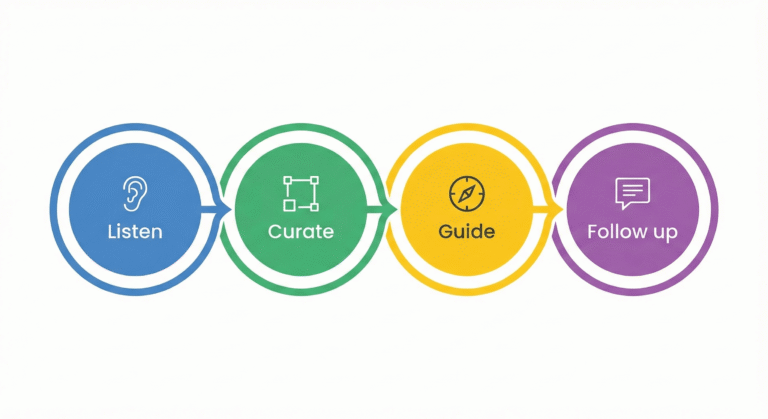
The beginner CX framework: Listen → Curate → Guide → Follow up
This framework is intentionally simple. It’s designed to keep your retail experience consistent even when you’re busy, new, or working with different staff styles.
1) Listen (what does the customer actually want?)
In personal shopping, “listening” isn’t only hearing words, it’s clarifying the goal.
At a beginner level, your job is to learn:
Occasion: What are they shopping for? (daily use, gift, event, upgrade)
Preferences: Style, size, comfort, budget comfort zone
Constraints: Time, availability, must-haves
Decision style: Are they confident or uncertain?
A simple line that works well:
“Before I recommend, what matters most to you today, comfort, style, budget, or a specific use?”
This feels helpful, not intrusive.
2) Curate (reduce choices so the customer can decide)
Customers often don’t need “more options.” They need fewer options that make sense.
A beginner way to curate is 3 choices max:
Safe choice: the most reliable everyday option
Value choice: best balance of price + benefit
Bold choice: the option that upgrades style/impact
You’re not hiding inventory, you’re reducing decision fatigue.
If a customer asks for “everything,” you can respond:
“I can show you more, but first I’ll start with three that match what you said, so it’s easier to compare.”
3) Guide (help them feel confident, not pressured)
Guiding is not pushing. It’s helping the customer compare and choose with less stress.
A beginner guiding pattern:
Restate their goal in one sentence
Show the difference between the curated options
Recommend one option and explain why it fits their stated priority
You don’t need “perfect words.” You need clear logic:
“Because comfort is your priority and you’ll use it daily, this option is the best fit. If you want a more premium feel, this one is the upgrade.”
4) Follow up (keep the relationship alive)
Follow-up isn’t only for big purchases. It’s how you turn a one-time sale into a relationship.
Beginner follow-up can be simple:
Confirm their decision timeline (“today vs later”)
Offer a short recap (“what we selected and why”)
Provide a clear next step (reserve, pickup, DM link, next live time)
Personal Shopping & Livestream Skills course page:
https://www.greenmotionacademy.com/shopping-livestream-training/
Practical example: one customer, two journeys (in-store vs livestream)
Here’s a high-level example that shows how the same framework adapts to different contexts, without giving away training scripts.
Scenario: The customer wants a “reliable gift” but feels unsure
They’re worried about:
-
choosing the wrong item
-
budget vs quality
-
whether the recipient will like it
In-store journey (personal shopping approach)
-
Listen: Ask about recipient, occasion, budget comfort, style preference
-
Curate: Present three options (safe/value/bold)
-
Guide: Compare using two simple dimensions (usefulness + perceived quality)
-
Follow up: Offer exchange/return clarity and a quick “gift-ready” wrap option
Livestream journey (how it changes)
On live, you don’t get deep 1:1 dialogue with every viewer. So you:
-
Ask one clarifying question to the audience (poll-style)
-
Present the same 3-option structure
-
Give a simple comparison (why each option fits a different type of buyer)
-
End with a clear next step (how to choose, what to comment, where to buy)
That’s it. Same framework, different delivery.

A light livestream checklist (prep → go live → after)
This is a high-level checklist, enough to be useful, not a full playbook.
1) Prep (15–30 minutes)
-
Setup: stable tripod, good lighting, clean background
-
Product order: decide the sequence (start strong, then variety, then best sellers)
-
Talking points: 3 points per product (problem → benefit → who it’s for)
-
Trust note: avoid exaggerated claims; be clear about price/stock/returns
-
Consent: never show customers or private areas without permission
2) Go live (keep it structured)
-
Start with one sentence: what this live is about
-
Show products one by one with consistent structure
-
Invite simple engagement: “comment your budget range” / “vote option A or B”
-
Keep the tone calm and helpful, viewers can feel pressure instantly
3) After live (make it repeatable)
-
Note what worked: what product got the most questions?
-
Save 3 ideas for next live (based on viewer questions)
-
Clip one useful moment into a short video (if your workflow supports it)
TikTok Shop Training blog post :
https://www.greenmotionacademy.com/tiktok-shop-training-advanced-sales-product-marketing-sg/
Trust-first selling: what to avoid (and what to do instead)
Personal shopping and livestream selling win long-term when trust stays high.
Avoid these common mistakes
-
Over-claiming: “This works for everyone” or “best on the market”
-
Filming without consent: even accidental background customers
-
Pressure language: “Buy now or you’ll regret it”
-
Too many options: confusion kills conversion
-
Ignoring customer fit: selling what you want, not what they need
Do this instead
-
Be specific and honest: “This is best if you want X; if you need Y, choose this other option.”
-
Use clear comparison: comfort vs style vs value
-
Keep follow-up respectful: offer help, not pressure
-
Always prioritise privacy and local compliance
For policy and compliance references, use official bodies (PDPC/ASAS/CASE) and platform documentation, not informal sources.
Next step: learn faster with guided training
This blog gives you the overview: the framework and the mindset. Training is where these skills become natural, through guided practice, coaching feedback, and repeatable tools you can use as a team.
Want to build confident personal shopping experiences and livestream skills with structured guidance?
-
Explore the course → https://www.greenmotionacademy.com/shopping-livestream-training/
-
Request intake details → https://www.greenmotionacademy.com/enroll-now/
-
Book a call / ask a question → https://www.greenmotionacademy.com/contact-us/
About Us: https://www.greenmotionacademy.com/about-us/
Blog : https://www.greenmotionacademy.com/blog/

You may also like
TikTok Shop Livestream Selling Checklist: A Beginner-Friendly Framework (Flow + Metrics + Trust)
Most beginner livestreams don’t fail because the host lacks confidence—they fail because the live has no structure. Viewers arrive, feel uncertain about what’s happening, and leave before the product story becomes clear. This article gives you an overview-level TikTok Shop …
EV Technical Training Basics: A Safe Beginner Overview of EV Systems, Batteries, Charging & Diagnostics
If you’re new to EV technical learning, it can feel like there’s “too much” at once: batteries, charging, power electronics, software, and safety rules. The good news is you don’t need to master everything to start, you need a safe …
EV customers don’t just buy a vehicle—they buy into a new routine. Charging, range confidence, and long-term value can feel unfamiliar, even for customers who already like the idea of going electric. That uncertainty is exactly why EV sales works …